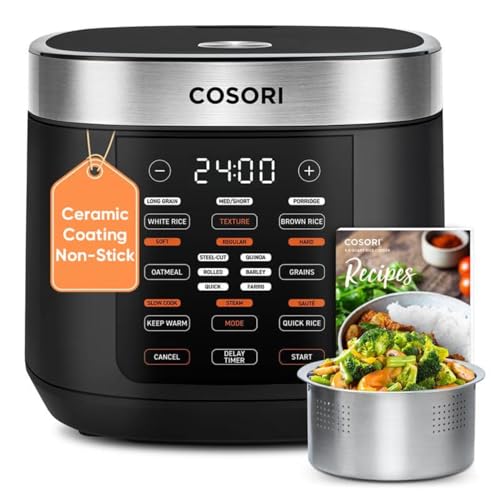
The COSORI 10-Cup Rice Cooker, model CRC-R501-KUS, is a 5-quart multicooker that treats rice as the headline feature and adds oatmeal, other grains, steaming, sautéing and slow cooking. It is the budget-tier large-capacity option in our selection and is built for families that want one affordable pot for many jobs. This profile sticks to what COSORI says on its product page, and points out how its capacity wording differs between sections. For where it lands against the other nine cookers, see our best rice cookers of 2026.
We do not cook with these machines. All specifications come from COSORI’s product page, and we call out claims as COSORI’s.
The Short Version
According to COSORI, the CRC-R501-KUS has a 5 qt / 10-cup capacity, a 1,000 W rating on 120 V AC at 60 Hz and weighs 9.3 lb. It measures 12.3 x 10.6 x 9.2 inches. It uses fuzzy logic, an LED guided touch display, clear measurement marks and an alert tone. COSORI lists 18 functions and includes an inner pot, a 3.0-quart steam basket, a standing rice paddle, a measuring cup, a recipe book, a user manual and a quick reference guide. The warranty is a 2-year limited warranty.
Heating Type, Explained Plainly
COSORI describes the cooker as fuzzy logic: a control system that adjusts temperature and cooking time through the cycle, which COSORI calls a 6-step rice cooking process. In plain terms, it is a computer-controlled cooker with conventional heating under the pot. COSORI’s page does not mention induction heating or pressure. That puts it in the same broad class as Tiger’s micom cookers and Zojirushi’s NS-series, and below the induction and pressure models at the top of our ranking.
Do not expect the finest control over texture. Where this type of cooker earns its place is in versatility, capacity and a lower price tier.
Capacity: Read This Part Carefully
The capacity wording is where COSORI’s page needs a careful read. The spec table lists “5 qt / 10 cup* (uncooked rice)”. The FAQ on the same page says the cooker “can prepare up to approximately 10 cups of cooked rice” and adds that actual capacity may vary with the type of rice and the measurement used. Ten cups uncooked and ten cups cooked differ by a factor of two or more, and the page does not reconcile the two.
What to do with that:
- Treat the pot’s measurement lines as the real limit, not the headline number.
- Use the measuring cup in the box, since rice-cooker cups differ from US measuring cups. Zojirushi, for comparison, uses a 180 mL cup of about 6.1 fl oz; COSORI does not state the volume of its own cup on the page we read.
- For regular family dinners, a pot this size has headroom either way. For feeding eight or more, or for meal prep, confirm the dry-rice line on the pot before you cook a full batch.
Menus and Functions
COSORI’s “18-in-1” description is built from these groups: different types of rice and texture options, 3 types of oatmeal, 3 types of other grains, and functions such as Slow Cook, Steam, Sauté, Keep Warm, Delay Timer and Quick Rice. COSORI’s FAQ names Rice, Grains, Oatmeal, Steam and Slow Cook, and says available functions may vary with the selected settings. We do not have a full list of every setting name, so we do not reproduce one.
Practical points:
- Rice: white, brown and sushi are named in COSORI’s FAQ, with texture options.
- Oatmeal and grains: useful for breakfast and for quinoa; COSORI names quinoa as an example.
- Steam: the 3.0-quart steam basket lets you steam vegetables.
- Slow cook and sauté: COSORI says soups and slow-cooked dishes are possible. A rice cooker is not a replacement for a dedicated slow cooker or a pan, but one pot can handle simple one-pot meals.
- Delay timer: load the pot ahead of time and have food ready later.
- Guidance: the touch display walks you through each step, which helps beginners; COSORI says the cooker takes care of the process after you press start, as long as you measured ingredients with the included cup.
A free recipe book with 30 chef-created recipes is included, with more on the VeSync app.
Inner Pot, Accessories and Cleaning
COSORI calls the inner pot nonstick. It does not describe the coating in more detail on the page we read, and we make no claims about it beyond what COSORI says: the pot, steam basket, rice paddle and measuring cup are all dishwasher safe. That is a real advantage over the Zojirushi NS-ZCC10 and NS-LGC05, whose manuals tell you to hand wash the pan. For the exterior, COSORI says to wait until the appliance is completely cool, then wipe it with a damp cloth.
As with any nonstick pot, using a plastic or wooden paddle (the included standing paddle) and not scraping with metal tools is sensible. COSORI’s page does not say whether replacement inner pots are sold, so ask before assuming you can replace one cheaply.
Keep Warm and Timer
COSORI says Keep Warm turns on automatically when a cycle finishes and maintains serving temperature. The page does not give a maximum time and notes that duration and performance can vary with usage. We suggest treating keep warm as a holding mode for a meal, not storage, and refrigerating leftovers promptly. The delay timer lets you set cooking to finish later, though for rice and perishable add-ins you should keep the delay short.
Size, Weight and Power at 120 V
At 9.3 lb and 12.3 x 10.6 x 9.2 inches, the COSORI is heavier and bulkier than 5.5-cup cookers such as the Tiger JBV-A10U, which Tiger lists at about 5.7 lb. Its 1,000 W rating is well above the 672 W Tiger lists for the JBV-A10U, so avoid sharing the outlet with another high-draw appliance while it cooks. It also releases steam, so do not place it under a low cabinet.
Who Should Buy It
- Families of four or more who want one big pot for rice and oatmeal.
- Budget shoppers who want steam, slow cook and sauté in one appliance.
- Beginners who like a guided touch display and a recipe book.
- Anyone who wants dishwasher-safe parts.
Who Should Skip It
- Rice purists who want the finest texture control; see the Zojirushi and Cuckoo premium models in our comparison.
- Small households and dorm rooms: the cooker is large for one or two people. A 3-cup model such as the Zojirushi NS-LGC05 is better suited.
- Buyers who need a clear, dependable rated capacity before they buy, given the page’s mixed signals.
- Cooks who want pressure cooking; for that, the Cuckoo CRP-P0609S is the closer fit.
How It Compares to Its Neighbors
Against the Tiger JBV-A10U, the COSORI is nearly twice as large and has far more functions, but the Tiger’s tacook plate can cook a second dish above the rice at the same time, and the Tiger has a lighter 5.7 lb body. The COSORI suits big households, the Tiger suits a small one-pot dinner.
Against the Cuckoo CRP-P0609S, the COSORI lacks pressure but gives a bigger pot, slow cook, sauté and dishwasher-safe parts. The Cuckoo adds pressure cooking, while the COSORI is the broader appliance.
Verdict
The COSORI 10-Cup is an easy pick for large households that want flexibility and a short learning curve. Its drawbacks are the capacity wording, no induction or pressure and a footprint that is large for what is, at heart, a rice cooker. If those fit your kitchen, it is a practical, low-fuss option. You can see the current price on Amazon.
Sources