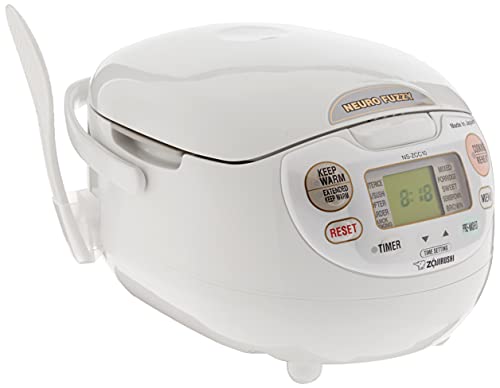
The Zojirushi NS-ZCC10 is a classic “Neuro Fuzzy” rice cooker: a 5.5-cup machine that uses conventional heating with a computer that adjusts temperature and time as the rice cooks. It sits in the middle of our lineup. It is simpler and lighter than the induction and pressure models above it, and and has more menu options than the basic micom cookers below it. This profile covers what it does, how it is built, who it suits and who should look elsewhere. To see where it lands against all ten cookers we picked, read our best rice cookers of 2026 comparison.
We do not cook with these machines ourselves. Everything below comes from Zojirushi’s product page and the English section of its instruction manual, and we say so when a point is the maker’s claim.
The Short Version
According to Zojirushi, the NS-ZCC10 is made in Japan, is cETLus listed and runs on 120 V at 680 W. It holds up to 5.5 cups (1.0 L) of rice. The Zojirushi page lists Neuro Fuzzy logic, automatic keep warm with an extended keep warm and reheat cycle, a spherical inner cooking pan, a two-setting delay timer and a built-in retractable power cord. The same model number also exists as the NS-ZCC18, a 10-cup version with a 1,000 W rating. The Amazon listing we link to is the 5.5-cup NS-ZCC10, and every number below refers to that size.
What “Neuro Fuzzy” and Direct Heating Mean
Rice cookers differ mainly in how they heat. The NS-ZCC10 uses what the manual calls a direct heating system: a heating plate under the pot, with a sensor in the center that reads the pot’s temperature. Zojirushi says its Neuro Fuzzy logic lets the cooker “think” for itself and make fine adjustments to temperature and heating time. In plain terms, it adapts to the amount of rice and water and to the menu you choose instead of running a fixed timer.
Induction heating (IH), used in Zojirushi’s NP-HCC10 and NW-QAC10, makes the pot itself the heat source, which generally gives finer control. Pressure models, such as Zojirushi’s NW-JEC18 or Cuckoo’s pressure cookers, raise the cooking temperature further. The NS-ZCC10 skips both. That is why it is lighter, draws less power and is easier to live with, and also why we place it below the IH models for people who cook rice every day and care about texture.
Capacity and the 180 mL Rice Cup
A rice-cooker “cup” is not a US measuring cup. Zojirushi measures capacity in its supplied rice measuring cup, which it lists as approximately 6.1 fl. oz. (180 mL), using raw short grain white rice. A rice-cooker cup of rice is therefore a little smaller than a standard 8 fl. oz. US cup, and Zojirushi notes that other grains may vary.
The manual’s specification table for the NS-ZCC10 gives these ranges:
- White rice and quick cooking: 1 to about 5.5 cups
- Sushi rice: 1 to about 5.5 cups
- Mixed rice: 1 to 4 cups
- Semi-brown and brown rice: 1 to 4 cups
- Porridge: 0.5 to 1.5 cups
- Sweet rice: 1 to 4 cups
Cooked yield is larger than the raw amount because rice expands as it absorbs water. For a household of two to four people eating rice with dinner most nights, 5.5 cups raw is generous. If you often cook for six or more, or batch-cook for the week, look at the 10-cup version of the same cooker, or at a bigger model from our lineup.
Menus and Cooking Times
Zojirushi lists these menu settings: white (regular/sushi, softer or harder), mixed, porridge, sweet, semi-brown, brown, rinse-free and quick cooking. The white rice settings are the useful part. You set the water to the white rice line, then choose regular/sushi, softer or harder, and the cooker cooks to that texture. Zojirushi’s manual describes softer as glutinous and full, and harder as crisp and elastic, suited to dishes such as curry. The cooker also remembers the last texture you chose for white, semi-brown and brown rice.
The manual gives typical cooking times for the 1.0 L size that depend on the amount of rice and the conditions. For white rice, regular takes roughly 48 to 55 minutes, harder roughly 37 to 44 minutes and quick cooking roughly 36 to 42 minutes. Brown rice takes much longer, about 84 to 107 minutes in the manual’s table. Mixed rice needs more time because of a pre-heating stage. The manual notes that quick cooking can leave rice slightly harder than normal.
Two practical notes from the manual. First, rice does not need to be soaked beforehand, although pre-soaked rice may come out slightly softer. Second, if you cook batches back to back, wait until the main body, outer lid and inner lid have cooled, because hot parts can make it hard to cook the next batch properly. The manual also says not to open the outer lid during cooking.
Keep Warm, Reheat and the Timer
Keep warm starts automatically when cooking finishes. There is also an extended keep warm setting, which Zojirushi says holds rice at a slightly lower temperature, about 140 degrees F, to reduce dryness, discoloration and odor. The manual lists limits worth knowing:
- Do not keep rice warm for more than 12 hours.
- Do not add cold rice to warm rice or keep food other than white rice warm.
- Extended keep warm is not available for mixed, sweet, porridge, semi-brown or brown rice, and it switches back to regular keep warm after 8 hours.
- Leave no spatula in the pan during keep warm.
The reheat function brings kept-warm rice up to eating temperature in about 5 to 8 minutes, according to the manual, but it is meant for white rice and should not be repeated. Treat keep warm as a short holding mode rather than storage, and cool and refrigerate leftover rice promptly.
The delay timer has two presets, so you can load the pot in the morning and have rice finish when you walk in. Set the clock first, as the manual says, and skip the timer for quick cooking, mixed and sweet rice. In hot weather, the manual advises against setting the timer for more than about 8 hours with pre-washed rice.
Inner Pan, Cleaning and Care
The inner pan is a spherical, nonstick-coated pan. Zojirushi’s manual says to soak and wash the pan, spatula and inner lid with a sponge in warm or cold water, and not to leave the pan soaking so long that the top rim rusts. To protect the coating, avoid brushes and abrasive cleansers and clean the pan promptly after cooking with seasonings. Wipe the heating plate and the center sensor clean, since rice grains or water on them can affect cooking. The inner lid is removable, though the manual says the lid gasket cannot be removed. Do not clean with thinner, benzene or bleach.
Replacement parts, including pans for both sizes and the inner lid, are listed on Zojirushi’s own store page.
Size, Weight and Power at 120 V
Zojirushi lists the NS-ZCC10 at 10-1/8 x 13 x 8-1/8 inches (W x D x H) and about 6.4 lb, drawing 680 W on a standard 120 V circuit. Average keep-warm consumption is given as about 37 W. The cord is stored in the body and retracts, which helps if the cooker lives in a cabinet. At 680 W it runs comfortably on a normal kitchen outlet. Zojirushi’s manual cautions against plugging other devices into the same outlet and against extension cords with a lower rating than the appliance.
Who Should Buy It
Pick the NS-ZCC10 if you:
- cook for two to four people and mostly make white, sushi or brown rice;
- want a simple Zojirushi without paying for induction or pressure;
- value a light machine with a retractable cord and a simple menu;
- plan to keep rice warm for a dinner, not for days.
Who Should Skip It
Skip it if you:
- want the most precise texture control and cook rice daily; look at Zojirushi’s induction models in our rice cooker comparison;
- cook for one person or live in a dorm, where a 3-cup cooker takes less space; see the Zojirushi NS-LGC05;
- need steel cut oatmeal, GABA brown or long grain presets, which the NS-LGC05 lists and this model does not;
- want a dishwasher-safe pot; Zojirushi tells you to wash this one by hand;
- live at high elevation, where the manual warns of operating problems.
How It Compares to Its Neighbors
Against the Zojirushi NS-LGC05, the NS-ZCC10 holds nearly twice the rice (5.5 cups versus 3), uses a stronger 680 W element versus 450 W and has two keep-warm modes. The NS-LGC05 counters with a lighter body, a fold-down handle and extra menus for GABA brown, long grain and steel cut oatmeal. The NS-ZCC10 is the better fit for a family dinner, and the LGC05 for one or two people.
Against the Tiger JBV-A10U, which has the same 1.0 L size, the NS-ZCC10 offers a far richer rice menu and an extended keep warm, while the Tiger offers a cooking plate that lets you steam a second dish above the rice. If rice quality is the priority, the Zojirushi makes more sense; if one-pot dinners matter more and the budget is tight, the Tiger is the alternative.
Verdict
The NS-ZCC10 is a dependable, mid-range choice for households that want good everyday rice with minimal fuss. It does not have the finesse of induction or the versatility of pressure, and its menu leaves out some of the newer grain settings. For two to four people who eat white, sushi and brown rice, it is a straightforward pick. You can check the current price on Amazon, where the 5.5-cup white model is listed.
Sources