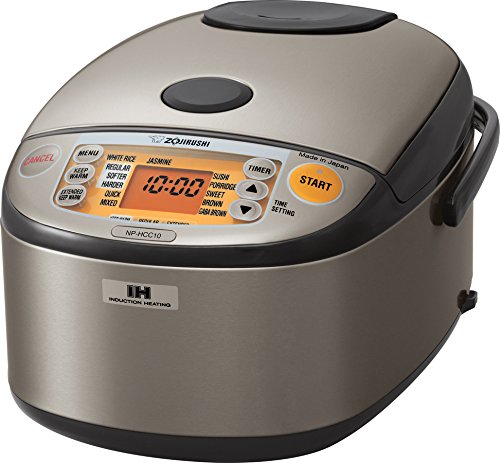
The Zojirushi NP-HCC10 is a 5.5-cup induction heating (IH) rice cooker in a stainless dark gray finish. Zojirushi lists it on its own site as part of the NP-HCC10/18 pair. It does not use pressure and it does not have a flashy touchscreen, which is part of the appeal: it is a straightforward cooker that heats the pot with induction and leaves the rest to the menu buttons. This profile covers who it suits, how it differs from the cookers above and below it in our ranking, and what to know about size, power, cleaning and keep warm. For the full list, see our best rice cookers of 2026.
We do not cook with these machines. All specifications come from Zojirushi’s product page and instruction manual, which we read, and we attribute claims to Zojirushi.
The Short Version
Zojirushi says the NP-HCC10 uses induction heating to heat the inner cooking pan, which allows precise temperature adjustments. It adds a triple heater (bottom, side and lid) that generates heat all around the pan for even heating, brown and GABA brown settings, automatic and extended keep warm, and a two-setting delay timer. The exterior is clear-coated stainless steel that Zojirushi says is easy to clean. It is made in Japan and cETLus listed.
It is the cooker for two to four people who want better rice than a basic cooker gives them and do not need pressure.
Key Specs According to Zojirushi
- Model: NP-HCC10 (the Amazon listing is the NP-HCC10XH, Stainless Dark Gray).
- Capacity: up to 5.5 cups / 1.0 liter, measured with the 180 mL (about 6.1 fl. oz.) cup and raw short grain white rice.
- Size (W x D x H): 10 x 14 x 8 inches.
- Electrical rating: 120 volts / 1,230 watts.
- Heating: induction heating with a triple heater (bottom, side, lid).
- Safety listing: cETLus listed.
- Origin: Made in Japan.
- Manual languages: English, French, Traditional Chinese, Korean, Japanese and Vietnamese.
Zojirushi also lists a larger NP-HCC18 (up to 10 cups) on the same page. This profile is about the 5.5-cup NP-HCC10.
Cups, Briefly
The “cup” in a rice-cooker rating is a 180 mL scoop that comes in the box, about 6 fluid ounces, or three-quarters of a US measuring cup. A 5.5-cup cooker therefore holds about a liter of dry rice at most. In practice that makes a pot of cooked rice big enough for a family dinner plus leftovers, but not a party. Use the supplied cup and the water lines inside the pan, and adjust the water slightly if you like softer or firmer rice, as the manual suggests.
How Induction Heating Works
A basic rice cooker heats a plate under the pot and tracks the temperature at one point. Induction heating uses a coil under the pot to create a magnetic field that warms the pan directly. Zojirushi says this lets the cooker make precise temperature adjustments, and its sister page for the NW-QAC10 adds that IH heats and cools faster than a heating element, which allows finer adjustments while cooking.
The NP-HCC10 adds heaters in the side and the lid, so the pan is warmed from several directions. Zojirushi says this generates heat all around for even heating, which is useful because the top layer of rice in a cooker with only a bottom heater can cook differently from the bottom layer. The result, according to Zojirushi, is exceptional rice. We cannot confirm the texture ourselves.
According to Zojirushi, the menu settings include:
- White rice in regular, softer or harder textures
- Jasmine white rice
- Mixed rice
- Sushi rice
- Porridge
- Sweet rice
- Brown rice
- GABA brown rice
- Quick cooking
That list covers what most American households cook: short grain and medium grain white rice, Jasmine, brown, sushi rice and the occasional bowl of porridge. According to Zojirushi’s manual, the GABA brown setting keeps the pan at about 104°F (40°C) for about 2 hours before the main cook, so the cycle takes about 3 hours. Long grain basmati or parboiled rice is not named on the menu, so you would probably use the regular white setting and check the water level.
The manual notes that the timer function is not available in the quick, mixed and sweet settings, and it advises against using the timer when you add ingredients or seasonings, since they may spoil. The two timer slots come preset at 6:00 and 18:00 and can be changed.
Preparing the Rice
Zojirushi’s manual says the rice can be cooked immediately after cleaning, since soaking is not required, and that soaking will soften the texture. It also tells you to remove foreign matter such as stones, not to use whisks to clean the rice, and not to put a metal strainer in the pan, all to protect the coating. After cooking, loosen the rice with the spatula soon after the cycle ends to let moisture escape.
The Inner Pan, Cleaning and Care
The inner cooking pan has a nonstick coating. The manual says the coating may eventually discolor or peel with use, that this does not affect cooking or keep warm performance, and that you should replace the pan if the coating concerns you. Zojirushi sells replacement pans for the 5.5-cup model.
To clean it, wait for the cooker and pan to cool, then use a soft sponge. Do not use abrasive cleaners, bleach, thinner, benzine, nylon or metal brushes or melamine sponges. The manual says not to use a dishwasher or dish dryer, because that may cause scratches, deformation or discoloration. The inner lid set and steam vent set come off for washing and must be reattached correctly before the next use.
There is no self-cleaning cycle listed on the product page for this model, unlike the newer NW-QAC10, so plan on a quick hand wash after each batch.
Keep Warm
The NP-HCC10 offers automatic keep warm and an extended keep warm. The manual’s guidance: do not use keep warm for small amounts of rice for long periods, for more than 12 hours in Regular mode (24 hours in Extended mode), when adding rice, for reheating cold rice, for mixed or sweet rice with seasonings, or for foods other than rice such as croquettes or miso soup. Do not leave the spatula in the cooker. The manual also warns that rice can develop an odor if keep warm is cancelled or the cooker is unplugged with rice inside.
Treat keep warm as a way to hold dinner, not as storage, and cool and refrigerate leftover rice promptly.
Size and Power at 120 V
At 10 x 14 x 8 inches, it is a moderate countertop footprint, bigger than a basic micom cooker but smaller than the 10-cup models. At 1,230 W it is a substantial load on a 120 V kitchen circuit (about 10 amps). The manual says to use an outlet rated at 15 amperes minimum and not to plug other devices into the same outlet. That means no toaster oven or kettle on the same outlet at the same time.
Who Should Buy It
- Two to four people who eat rice several times a week.
- Cooks who want better temperature control than a basic cooker but do not want a pressure system.
- Anyone who prefers a plain stainless exterior and simple buttons to a touchscreen.
- Households that cook brown, white, Jasmine and sushi rice and want a setting for each.
Who Should Skip It
- One or two people who cook small batches. The 3-cup models in our ranking are better sized for that.
- Large families. Zojirushi makes a 10-cup version, or you could look at the Zojirushi NW-JEC18.
- Anyone who wants a steam tray or a quinoa setting. For that, see the Zojirushi NW-QAC10.
- Buyers who want pressure cooking for very sticky rice. Pressure is not part of this design.
How It Compares
Against the NW-QAC10, the NP-HCC10 is the older design. The NW-QAC10 has a flat-top design, a self-cleaning function, a steam function with a steaming tray and a quinoa setting, and draws less power (1,080 W per Zojirushi). The NP-HCC10 offers the sushi, sweet and mixed settings and the lid and side heaters. Against the NW-JEC18, it gives up pressure, the AI fuzzy logic system and 4.5 cups of capacity in exchange for a smaller body.
Bottom Line
The NP-HCC10 is an uncomplicated induction cooker from a company known for rice cookers. It fits a household that cooks rice often, wants consistent results and does not need pressure or extras. If you want a steam tray and easier cleanup, look at the NW-QAC10 first. See all of our picks in the best rice cookers of 2026.
See price on Amazon
Sources