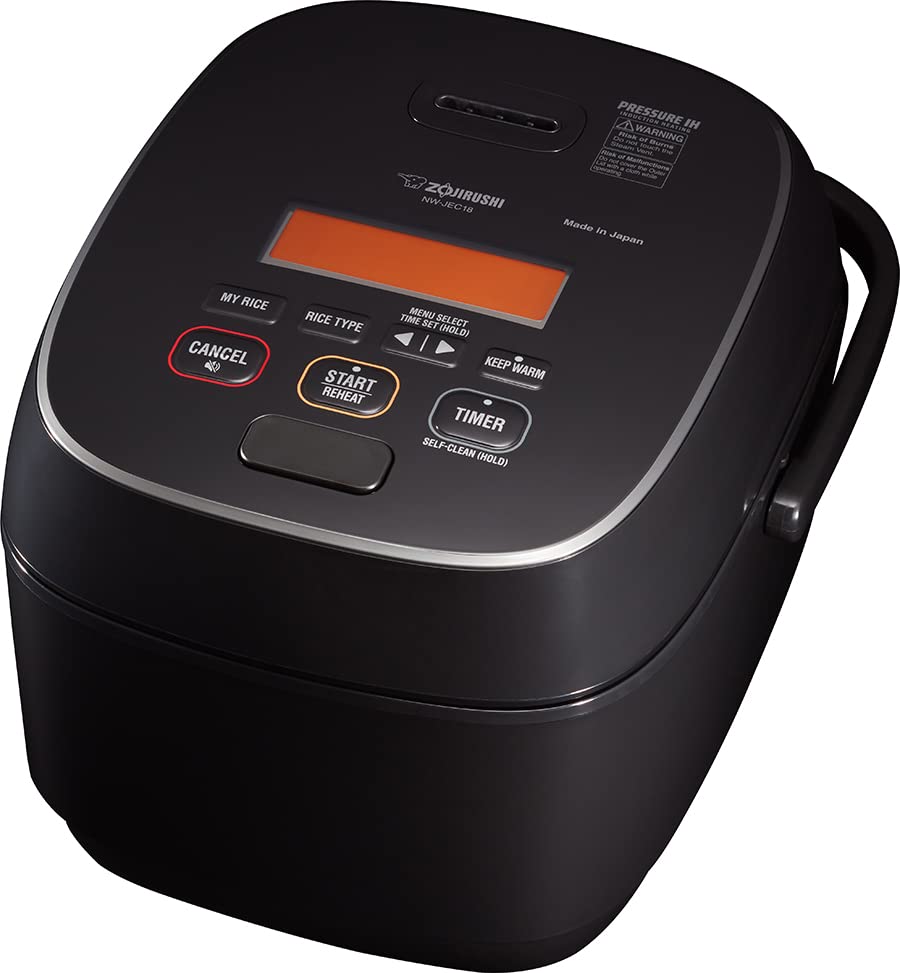
The Zojirushi NW-JEC18 is the 10-cup member of Zojirushi’s pressure induction heating family, and the company describes the line as its highest quality pressure induction heating rice cooker ever. It is made in Japan, it is big, and it is built around one idea: let the machine adjust the cooking cycle so the rice comes out the way you like it. This profile covers who that suits, what the heating system actually does, how big and power-hungry the cooker is, and when a simpler or smaller model is the better buy. For the full ranking, see our best rice cookers of 2026.
We do not cook with these machines ourselves. Everything below comes from Zojirushi’s own product page and instruction manual, which we read, and we say “according to Zojirushi” where a claim is the maker’s.
The Short Version
According to Zojirushi, the NW-JEC18 combines three things: pressurized cooking, induction heating (IH) and advanced fuzzy logic with AI that “learns” and adjusts the cooking cycle. A “My Rice (49 Ways)” setting lets you tell the cooker the texture you want. The inner pan is iron coated and platinum-infused nonstick, the menu list is long, and there is a self-cleaning function that reduces odors. It is cETLus listed and made in Japan.
It is a flagship, and it is sized like one. It suits households of four or more that cook rice most days and are particular about texture. If you cook for one or two people, it is overkill, and our picks for smaller households are covered elsewhere in the ranking.
Key Specs According to Zojirushi
- Model: NW-JEC18 (the Amazon listing is the NW-JEC18BA, Silky Black).
- Capacity: up to 10 cups / 1.8 liters, measured in the 180 mL (about 6.1 fl. oz.) rice measuring cup with raw short grain white rice.
- Size (W x D x H): 12 x 14-5/8 x 9-3/4 inches.
- Electrical rating: 120 volts / 1,370 watts.
- Heating: induction heating with pressure.
- Inner pan: 2.2 mm thick, highly conductive aluminum with stainless steel cladding, iron coated on the exterior, platinum-infused nonstick coating inside, water lines at every half cup.
- Safety listing: cETLus listed.
- Origin: Made in Japan.
- Manual languages: English, Traditional Chinese, Korean, Vietnamese and Japanese.
A Note on “Cups”
A rice cooker cup is not a US measuring cup. The cup that comes with the cooker holds 180 mL, about 6 fluid ounces, which is roughly three-quarters of a US cup. When Zojirushi says 10 cups, it means ten of those small cups of raw rice, and the water lines inside the pan are marked for that cup. Use the supplied cup, not a kitchen measuring cup, and the lines will work as intended. This is also why the 10-cup label sounds smaller or larger than it is when you compare with a cooker that is rated in cooked cups.
How the Heating Works
Most basic rice cookers heat a plate under the pot. Induction heating works differently: a coil creates a magnetic field that heats the pot itself, which is why the iron coating on the outside of this pan matters. Zojirushi says the iron coating helps generate and store heat efficiently for even cooking. Because the pot is the heat source, the cooker can raise and drop the temperature quickly and make finer adjustments.
Pressure adds a second lever. Zojirushi says pressurized cooking and steaming promotes gelatinization and produces sticky, plump rice. In plain terms, higher pressure raises the boiling point of the water in the pot, so the rice cooks at a higher temperature than it would in an open pot. Zojirushi builds in multiple fail-safe measures for this, including a large steam vent that prevents messy overflows and sensors that check the unit is set up properly. The manual repeats that pressure is applied during cooking and self-cleaning, so the outer lid must be closed properly and the pressure release devices should be checked for clogging before use.
The third piece is the AI fuzzy logic, which monitors the cooking and adjusts it. Zojirushi’s page does not explain how the algorithm works, so treat it as a manufacturer claim. What you can verify is that the cooker lets you choose a texture, and that “My Rice” adjusts the cooking flow to the texture you report back after tasting.
According to Zojirushi, the menu settings are:
- White rice in five textures: regular, soft, softer, firm and firmer
- Umami
- Mixed
- Sushi
- Jasmine
- Porridge (a thicker, Japanese-style porridge from short or medium grain rice)
- Congee (a thinner, Chinese-style porridge from Jasmine rice)
- Brown
- GABA brown
- Steel cut oatmeal
- Quick white and quick Jasmine
The GABA brown setting holds the rice at 104°F for 2 hours before cooking, according to Zojirushi, which works as an extended soak. The steel cut oatmeal setting can be paired with the delay timer so the oatmeal is ready in the morning.
For a household that eats several kinds of rice, this is the main argument for the NW-JEC18. Short grain, Jasmine, brown and sushi rice all have their own program, and white rice has five texture steps. A cooker with only a handful of menus will cook all of these, but you will be adjusting water and expectations more.
The Inner Pan, Cleaning and Care
The pan is thick (2.2 mm), clad and coated, and Zojirushi sells a replacement 10-cup pan. The manual says the nonstick coating may wear out with use and may eventually discolor or peel, and that this does not affect cooking performance. It also gives rules to protect the coating: do not place utensils or dishes in the pan, clean the pan right after using seasonings, use only soft cleaning tools such as a sponge, and do not use abrasive cleaners, bleach, nylon or metal brushes, or melamine sponges. The pan must not go in a dishwasher or dish dryer.
The lid has a removable inner lid set with a gasket and filter, which you detach and wash after each use. The self-cleaning function runs a cycle to reduce odors. Plan for a few minutes of handwashing after every batch. That is normal for pressure models, which have more lid parts than a basic cooker.
Keep Warm
The cooker has Regular Keep Warm and Extended Keep Warm. The manual tells you not to use keep warm for small amounts of rice for long periods, for 12 hours or more in Regular mode or 24 hours or more in Extended mode (this can differ by menu), for porridge, congee or steel cut oatmeal, for mixed rice with added ingredients, or for reheating cold rice. It also advises loosening the rice within 10 minutes after cooking and gathering a small amount of rice toward the center of the pan while it is kept warm.
Those are the maker’s rules for rice quality. Do not treat keep warm as a storage method for rice you will not eat that day; cool and refrigerate leftovers promptly.
Size and Power at 120 V
At 12 x 14-5/8 x 9-3/4 inches, the NW-JEC18 needs real counter space, and you need clearance above and around it because the lid opens and steam vents. At 1,370 W it draws about 11 amps on a 120 V circuit. Zojirushi’s manual says to use an outlet rated at 15 amperes minimum and not to plug other devices into the same outlet. If your kitchen has one crowded outlet near the counter, this is worth a thought before you buy.
Who Should Buy It
- Families of four or more that eat rice most days.
- Cooks who rotate between short grain, Jasmine, brown and sushi rice and want a setting for each.
- People who like to tune texture (softer, firmer) and have a cooker remember it.
- Anyone who wants a Japanese-made cooker with a full manual in several languages.
Who Should Skip It
- One or two people who cook small amounts. A cooker this size works best with a decent batch, and Zojirushi’s own keep-warm advice warns against holding small amounts for long periods.
- Small kitchens, dorms and anyone who stores appliances in a cabinet. Look at a 5.5-cup model instead.
- Anyone who wants a rice cooker that doubles as a slow cooker or steamer. The NW-JEC18’s menu is rice and grain focused.
- Shoppers who just want fluffy rice with minimal fuss. A simpler induction model does that with fewer parts.
How It Compares With Its Neighbors
The closest competitor in our ranking is the Cuckoo CRP-LHTR0609F, a twin pressure induction model that lets you choose pressure or non-pressure cooking. Cuckoo’s capacity is 6 cups uncooked (12 cups cooked), so its raw-rice capacity is smaller than the Zojirushi’s 10 cups. The Zojirushi is the larger, more rice-focused cooker; the Cuckoo is the choice if sticky Korean-style rice and a pressure/non-pressure switch matter most.
Below it in size sits the Zojirushi NP-HCC10, an induction model without pressure and at 5.5 cups. It has fewer menus, and it suits two to four people. If you like Zojirushi but do not need pressure or 10 cups, it is the more sensible step down.
Bottom Line
The Zojirushi NW-JEC18 is for people who treat rice as a staple and want the cooker to match. It pairs pressure with induction heating, a long menu list and a texture-tuning feature, at the cost of size, power draw and cleaning parts. If that sounds like your kitchen, it is the model to beat. If not, a smaller induction cooker makes more sense. Compare all ten in our best rice cookers of 2026.
See price on Amazon
Sources